How Parents Can Support Their Child's Coding Journey at Home
You do not need to know how to code to raise a confident young coder. What children need most at home is curiosity, consistency, and encouragement.
In this article
- 1. You do not need coding skills. You need good questions.
- 2. You do not need a coding room. You need a charged laptop and 30 good minutes.
- 3. Join the adventure, even if you are not touching the keyboard.
- 4. Celebrate bug-fixing like it is a gold medal event.
- 5. Hands off the mouse. Seriously.
- Final thought
Your child just built their first game. You have no idea how it works. Perfect.
That is not a parenting failure. That is actually a lovely place to begin. Because your child does not need a home coding expert. They need a grown-up who smiles, leans in, and says, "Show me what you made."
At CodeKutties, we have seen this again and again: the kids who grow fastest are not the ones with programmer parents. They are the ones with curious parents. The ones who clap for tiny wins, laugh at the silly bugs, and make coding feel exciting at home.
So if words like loop, variable, or debugging still sound a bit mysterious, relax. You are still fully qualified for this job. Here is how to be your child's favourite coding sidekick.
1. You do not need coding skills. You need good questions.
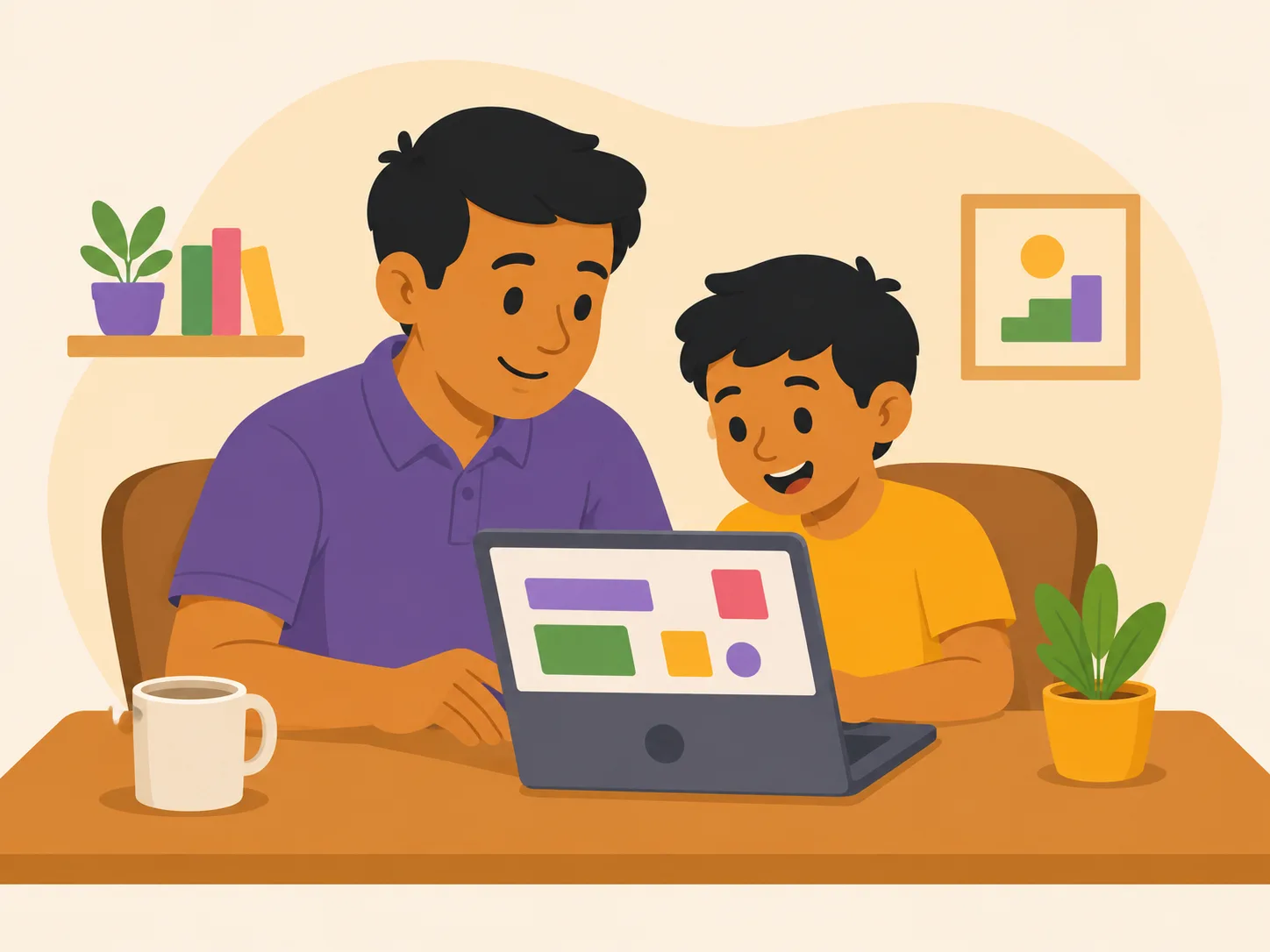
Kids can smell fake interest from a mile away. A quick "wow, nice" is sweet, but it is not the same as real curiosity. What they remember is when you pause, look at the screen, and ask something specific.
Try questions like: "What does this button do?" "Which part took the longest?" or "Can you teach me one new coding word today?" Suddenly your child is not just showing you a project. They are becoming the expert in the room.
And that is magic. When a child explains what a loop does by saying, "It is like my morning routine. Wake up, brush teeth, get dressed, repeat every day," they are not just answering you. They are understanding it better themselves.
2. You do not need a coding room. You need a charged laptop and 30 good minutes.
Parents sometimes imagine they need a Pinterest-perfect study corner before coding can happen. Not true. Your child is not launching a startup. They are learning to build cool things.
A simple setup works beautifully: a working device, decent internet, a quiet-ish corner, and a notebook for scribbles, ideas, and secret world-changing game plans. That is enough.
What matters most is rhythm. If coding always happens after snack on Tuesdays, or before dinner on Saturdays, it starts to feel natural. Like football practice. Like dance class.
3. Join the adventure, even if you are not touching the keyboard.
You do not have to learn Python with your child to be involved. You can play their game. Watch their animation. Let them "program" you to make a sandwich with step-by-step instructions.
That kind of playful involvement teaches a lot. It shows that coding is not some cold, serious thing trapped inside a laptop. It is logic, creativity, sequencing, problem-solving, and sometimes accidentally making Mum stand in the kitchen holding closed bread.
Even ten silly, engaged minutes can do more than an hour of hovering. When kids feel that adults enjoy what they are building, they keep building.
4. Celebrate bug-fixing like it is a gold medal event.
In coding, bugs are normal. Not scary. Not embarrassing. Just normal. They are basically the programming version of a spelling mistake before you hand in homework.
So yes, cheer when the final project works. But cheer even louder when your child says, "Wait, I found the mistake!" That moment matters more than parents realise. It is the moment frustration turns into confidence.
Try swapping "Did you finish it?" for "What did you figure out today?" It is a tiny change, but it tells your child that persistence counts.
5. Hands off the mouse. Seriously.
This is the big one. Your child gets stuck. You know exactly which button they should click. Your hand twitches. You move closer. You are ready to save the day.
Do not do it.
When parents grab the mouse too quickly, the message becomes: "I trust the computer more than I trust you to figure this out." A better move is to stay close and ask, "What do you want to try next?" Let them think. Let them guess. Let them test. That is where the real learning lives.
Final thought
Your child does not need a parent who can build apps. They need a parent who says, "Come here, show me," and means it.
That is the real secret. Not technical brilliance. Not perfect schedules. Not fancy setups. Just warmth, curiosity, and a little playful encouragement at the right moments.
So the next time your child runs over with a half-finished game, a dancing cat animation, or a project that only sort of works, lean in. Smile. Ask a question. Celebrate the wobble. That is how confident coders grow at CodeKutties.