You Use AI Every Day — And You Didn't Even Know It!
AI is already hiding in YouTube, Spotify, autocorrect, face unlock, and your favourite games. Once kids spot it, they start seeing the digital world very differently.
In this article
Quick question: did you watch YouTube today? Ask Siri something? Let Netflix pick a show? Let your phone fix a typo before you even noticed it?
If yes, congratulations. You already used AI. Probably more than once. Possibly before breakfast.
The funny thing about AI is that most kids imagine it as a giant movie robot with laser eyes. But real AI is usually much sneakier than that. It is tucked inside the apps, games, and gadgets you already use every day, quietly helping things work better.
So let us go hunting. Once you spot where AI is hiding, you will start seeing it everywhere.
1. So... what is AI, actually?
The easiest way to explain AI is this: it is a computer program that learns from examples and gets better over time.
Think about teaching a dog to fetch. The more times you throw the ball and reward the right behavior, the more the dog understands what to do. AI works in a similar way. It is shown lots of information, spots patterns, and learns what usually comes next.
That is why AI is called Artificial Intelligence. Artificial means humans made it. Intelligence means it can learn, decide, and improve. It is not magic. It is just very smart pattern-finding.
2. AI is already hiding inside your favourite apps
Once kids hear the word AI, they often think it lives in some faraway future. Not true. It is already sitting in your pocket.
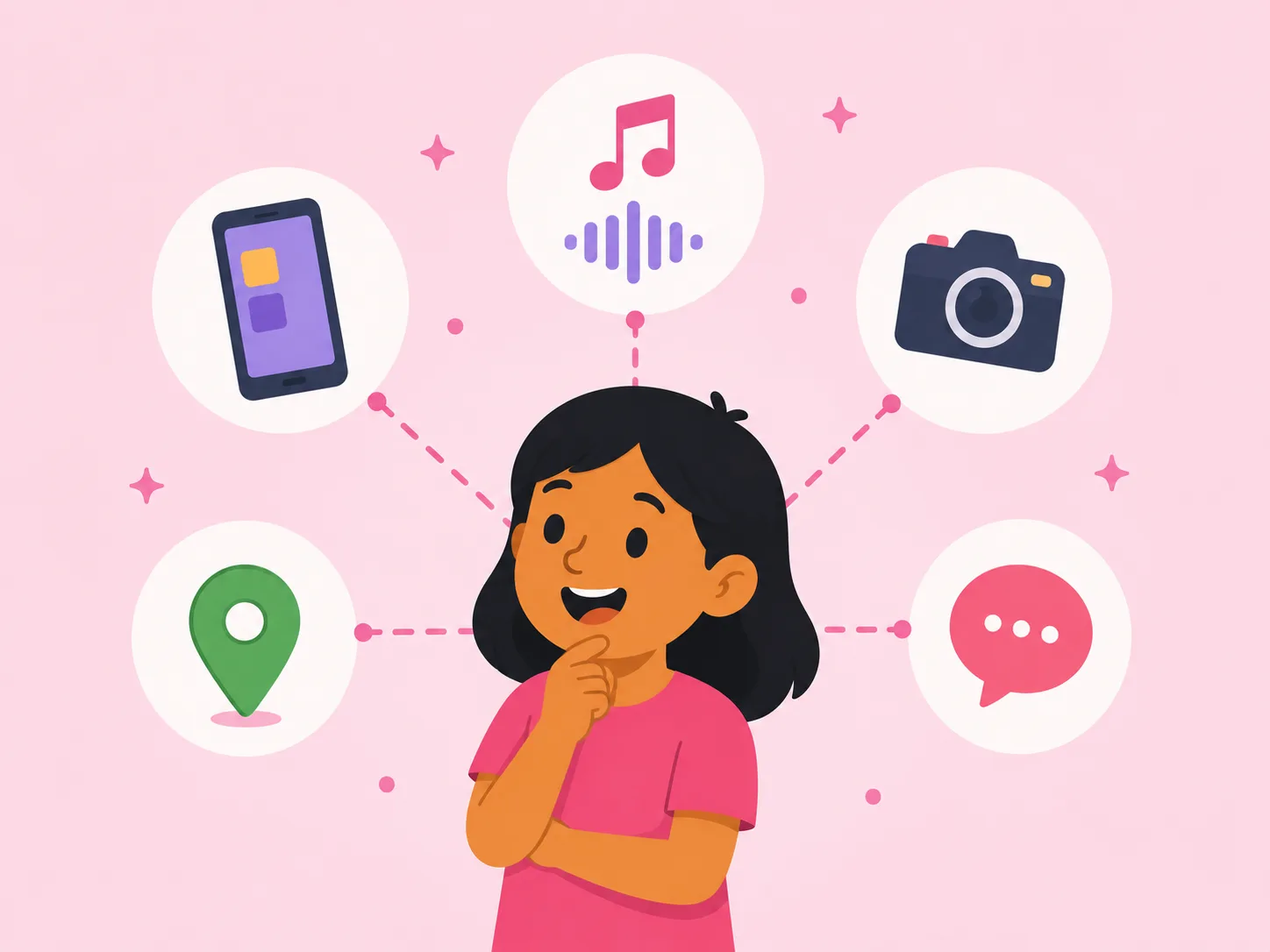
YouTube and Reels use AI to guess which video you will probably watch next. Spotify notices which songs you skip and which ones you replay 12 times in one day. Google starts predicting what you want before you even finish typing.
Autocorrect is AI too. Face unlock? Also AI. Even video game enemies often use AI to decide when to chase you, hide from you, or attack.
3. AI learns the same way kids do: with lots of examples
Imagine someone showed you hundreds of cat pictures. Fluffy cats. Angry cats. Tiny cats. Orange cats. After a while, if a new cat photo popped up, you would probably say, "Yep, that is definitely a cat."
AI learns like that too. It looks at tons of examples and slowly gets better at spotting patterns. The difference is that instead of seeing hundreds of examples, AI might look at millions.
That is why people often call it machine learning. The machine is not "thinking" like a human. It is learning from data the way kids learn from practice, repetition, and lots of "Ohhh, now I get it!" moments.
4. AI is cool... but people still teach it what matters
This part is important, especially for kids. AI does not wake up one day and decide what to do on its own. People build it, train it, test it, and tell it what to pay attention to.
That means humans are still the real decision-makers. AI can recommend a song or help unlock a phone, but someone had to teach it what success looks like first.
This is a great lesson for children because it turns AI from something mysterious into something understandable. Behind every "smart" app is a team of people asking questions, solving problems, and writing code.
5. Yes, kids can absolutely learn to build AI one day
Here is the exciting part: the people who built music recommendations, video suggestions, and smart search tools all started somewhere. None of them popped out of the womb building robots.
They learned logic. They learned coding. They practiced maths. They made mistakes. They fixed bugs. In other words, they started with the same building blocks kids can start with today.
That is why learning to code early matters so much. Every time a child practices instructions, patterns, sequencing, and problem-solving, they are building the exact muscles that make AI possible later.
Final thought
AI is not just the future. It is already here, tucked into your screen, your speakers, your search bar, and your games.
Once kids realise that, technology starts to feel less mysterious and much more exciting. They stop seeing apps as magic and start seeing them as things people build.
And that is the CodeKutties spark we love most: the moment a child stops asking, "What does this app do?" and starts asking, "Wait... could I make something like this too?"