Learning to Code in Malayalam: Why Mother Tongue Matters
The concept arrives in Malayalam. The keyword stays English. Why explaining a loop as aavarthanam helps a child in Kerala get to working code faster.
In this article
A boy in a Thrissur class, nine years old, sat stuck on a loop for most of a lesson. His teacher tried the explanation three different ways in English and got the same blank look each time.
Then she said one sentence in Malayalam. ആവർത്തനം. Doing the same thing again and again. He said "oh" and built the loop in about forty seconds.
He had understood loops the whole time. What he did not have was the English word standing in front of the idea, and nobody had noticed the difference because from the outside those two failures look identical.
This happens constantly in classrooms across Kerala, and it is almost always read as a child being slow at coding.
The word that was in the way
When a child cannot answer, there are two very different reasons, and telling them apart is most of the job.
Either they do not have the idea, or they have the idea and do not have your word for it. The first needs teaching. The second needs one sentence in the language they think in, and then they are away.
Coding makes this worse than most subjects, because it borrows ordinary English words and gives them strange new meanings. A variable is not variable. A string has no thread in it. A loop is not a shape. A child in Kerala is being asked to hold an unfamiliar idea inside an unfamiliar word, in their second or third language, while also watching a screen.
Drop one of those loads and the other two get much lighter. The cheapest one to drop is the language.
So here is the rule we teach to, and it does not bend.
The explanation, the story, the joke, the thing that makes the idea click, all of that can arrive in whatever language reaches the child fastest. The keyword they type stays exactly as it is. They will write for and if and print, in English, forever, because that is what Python actually accepts.
So there is no translated version of Python here and no attempt to make one. There is a Malayalam route to the same English keyword, which is a different thing entirely.
What it sounds like in a real class
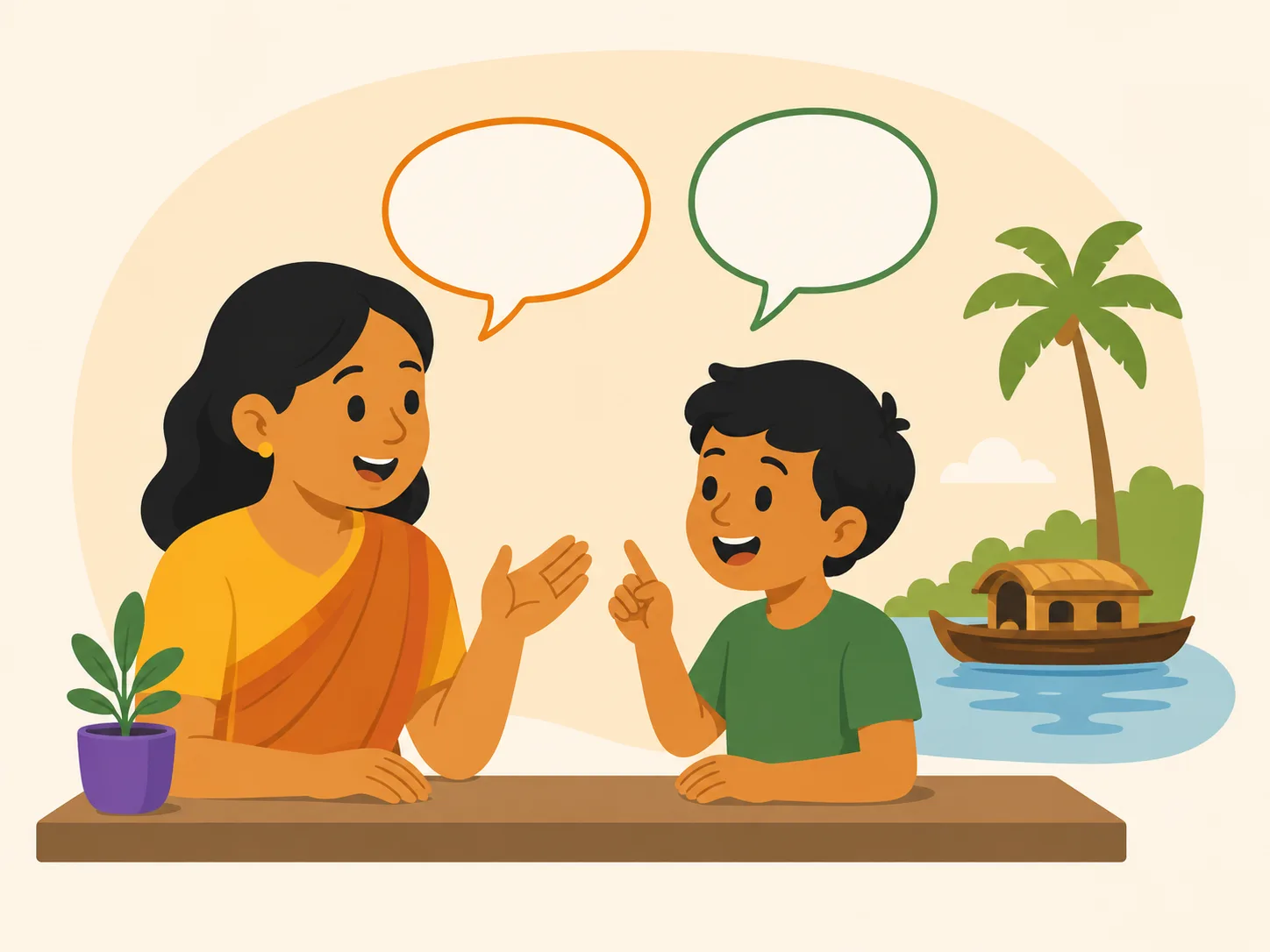
A loop stops being abstract the moment it is ആവർത്തനം, doing the same thing over and over, which is what the word already means to a child who has heard it at home.
A variable becomes ഒരു പെട്ടി. A box. You can put one thing in it, you can take it out, you can swap it for something else, and the box keeps its name whatever is inside. Nine-year-olds have never once struggled with the idea of a box.
A condition becomes എങ്കിൽ and അല്ലെങ്കിൽ. If this, otherwise that. Every child has been negotiated with in exactly that grammar since they could walk.
Then the code is typed in English, and the English words no longer feel like a wall, because the child already knows what is behind them:
peru = "Adithyan"

for i in range(3):
    print("Namaskaram, " + peru + "!")
Blocks make this easier, not harder
If your child is in a Scratch class rather than a Python one, this works even more in their favour, and it is worth knowing why.
In blocks, a child can see the shape of an idea before they read a single word of it. A repeat block visibly wraps around the blocks inside it. The wrapping is the meaning. A child who has never met the word repeat still understands, from the picture alone, that the inside part happens more than once.
So a younger child gets the idea first and the English label second, which is the right order and the opposite of what typing forces. By the time they meet the word for in Python, they are not learning a concept. They are learning a new name for something they have been building with for a year.
This is one of the quiet reasons blocks are worth the time rather than something to rush past. The reading load arrives separately from the thinking load. We set out what carries across in when a child is ready to move from Scratch to Python.
A child who understands ആവർത്തനം has understood loops. The English word is a label, not the lesson.
But will this hurt their English?
This is the first question Kerala parents ask, and it deserves a direct answer rather than reassurance.
No, and here is the specific reason. The technical vocabulary of a beginner coding course is remarkably small. Perhaps forty words, and every one stays English on the screen because the language demands it. Your child types them, reads them and sees them in error messages every session. That exposure does not reduce because a teacher explained the idea in Malayalam first.
What does reduce is the number of children who quietly decide they are bad at this. A child who fails five times in a row because of vocabulary does not conclude "my English let me down". They conclude "I cannot code", and that belief is expensive and sticky.
There is a second, more practical reason the English stays. Error messages are in English, they are terse, and reading them is a real skill in itself. We pulled that apart in what is left for your child to learn. A child who has been taught to read the word NameError rather than fear it is better off than one who was protected from it.
What you can do this week
You do not need to teach anything. You need to find out which of the two failures is happening when your child gets stuck.
All three of these take a few minutes and none of them require you to know any code.
- Next time your child is stuck, ask them to explain the problem to you in Malayalam. If they can, the idea is fine and the words were the problem.
- Ask what the English word for it is afterwards, so the label gets attached rather than skipped.
- Tell your child's teacher which language is spoken at home. Most will switch on the spot and nobody thinks to tell them.
Final thought
That boy in Thrissur is now the one in his class who explains loops to everybody else, and he does it in Malayalam first and English second, because that is the order it arrived in for him.
Nothing was dumbed down for him. He writes the same for loops as everyone else, gets the same error messages, and reads them in English. What changed was that the idea got to him before the vocabulary did, rather than being stuck behind it.
If you are trying to work out whether your child is making progress at all, the markers to watch are in how do I know my child is actually learning to code.
And if you want to hear what this sounds like rather than read about it, sit in on a free trial class. Our teachers in Kerala switch between both languages all lesson without being asked. One hour, no card needed.