If AI Writes the Code, What's Left for My Child to Learn?
AI produces code in seconds. Reading it, testing it and catching what is wrong is still a person's job. Here is what that looks like at age 11.
In this article
A student of ours, eleven, showed up to class last term looking pleased with himself. He had asked an AI tool to write his quiz game and it had produced sixty lines in about four seconds.
We ran it. It crashed on the second question.
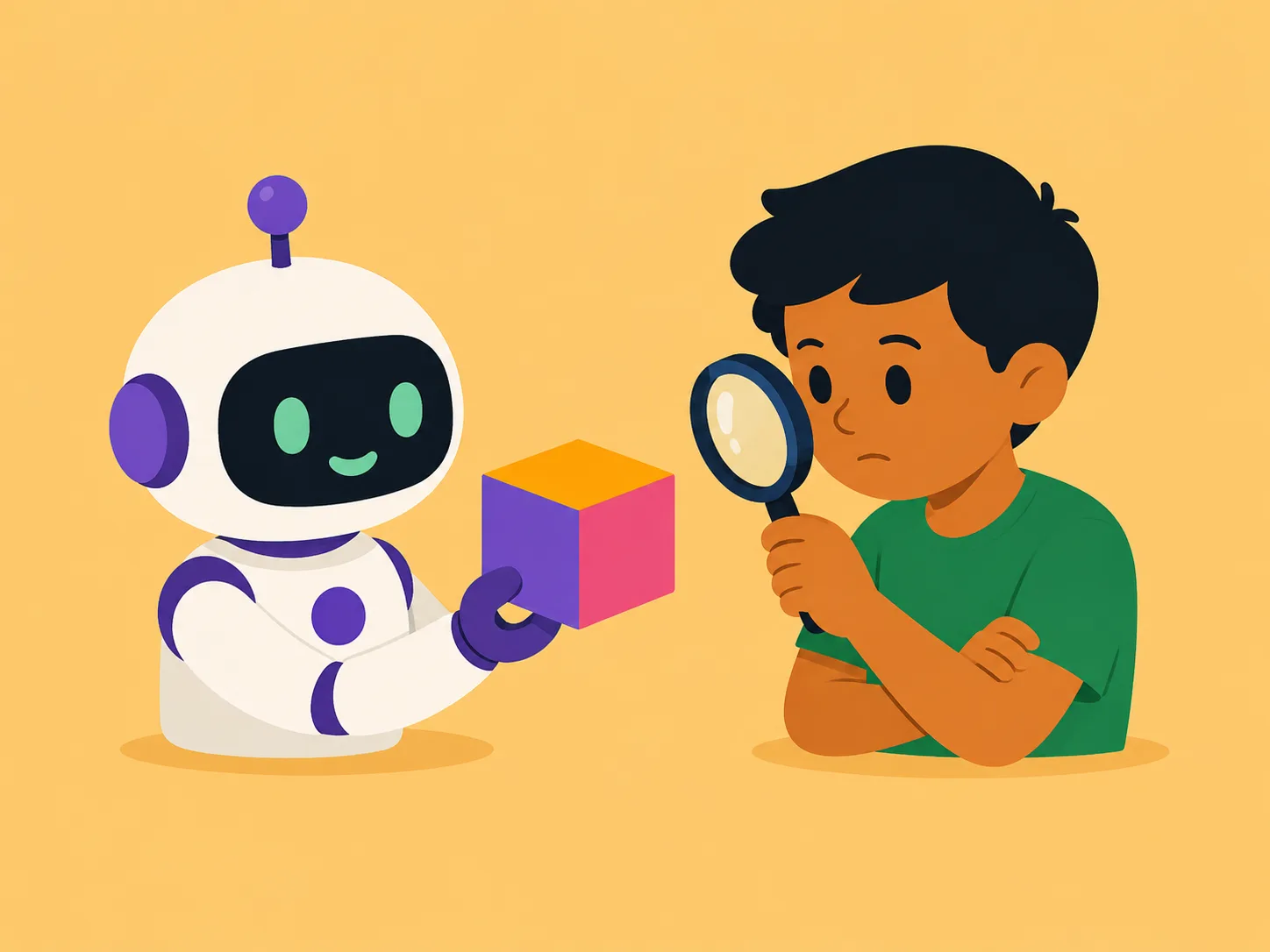
He stared at the error message for a while and then said the most useful sentence a child can say in a coding class: "I don't know what that means."
That is the honest state of things right now. Getting code is easy. Getting working code is a completely different job, and it is the job your child is actually learning.
Three jobs that used to look like one
Writing software used to feel like one continuous activity. You thought, you typed, you tested, all mixed together.
AI split that into three visible steps. You write a prompt. You get an output. Then somebody has to judge whether the output is any good. The first two steps are now nearly free. The third one has not moved an inch.
That third seat is the one your child is training for. It is not glamorous and it does not look like the movies, but it is where the value went. Sitting behind it is an even quieter question, knowing what to build at all.
A child who cannot read code gets stuck
Watch what happens when the judgement seat is empty.
The code does not work. The child cannot tell why, so they go back and ask again, slightly differently. New code arrives. It also does not work, possibly in a new way. Ask again. Ask again.
We have watched clever children lose forty minutes to this exact spiral. It is not a lack of effort. They simply have no way to tell a good answer from a broken one, so every attempt is a coin flip.
The child who can read even a little code breaks out of it immediately. They spot that the variable is empty, or that the loop never ends, and they fix one line. Two minutes, not forty.
Asking again is not debugging. It is just hoping, faster.
Testing is the new spelling check
The habit we care most about is small and unglamorous. Run it. Then try to break it.
Here are four lines that look completely reasonable and will not run. See if your child can spot the problem before the computer tells them.
score = 0
score = score + 5

print("Your score is " + score)
Why that tiny bug matters so much
The last line breaks because score is a number and the text is not, and Python will not glue those two together without being asked properly. The fix is to write print("Your score is", score) instead.
It takes eight seconds to explain and a surprisingly long time to stop making. That is the point. Your child is not learning a fact here, they are building a reflex: when something looks fine but does not run, go and look at the types.
This is also exactly the reflex AI tools do not reliably have. They produce confident, tidy, well-indented code that is wrong in small ways, and small ways are the hard ones to catch.
School rewards the right answer on paper. A program does not care about your working. It runs or it does not, and there is something wonderfully honest about that for a ten-year-old.
What you can do this week
None of this needs you to understand the code. It needs you to ask one good question at the right moment.
- When they show you something that works, ask "what would break it?" and let them try.
- Copy those four buggy lines above and ask them to find the mistake before running it.
- Ask them to explain one line of an AI answer back to you in their own words.
Final thought
So what is left for your child to learn? The part that was always hardest and is now the only part left standing.
Reading something a machine produced. Testing it properly. Knowing when confident-looking work is quietly wrong. And underneath all of it, having enough understanding to be the person in the room who can tell.
Our student with the crashing quiz game found the bug himself in week three. It was a missing colon. He was insufferable about it for days, and honestly he had earned it.
If you want the bigger picture on why this is a good thing rather than a worry, read why kids should still learn to code. If the jobs question is the one on your mind, it is your child won't compete with AI. And your child might prefer the version written for them.
Or skip all of it and bring them to a free trial class, then watch them find their own missing colon. One hour, no card needed.