You Don't Need to Know Python to Support a Child Learning It
Five questions to ask a child about their Python code, five more for a child working in blocks, and the one habit that beats knowing any syntax.
In this article
A mother in Kozhikode told us she had bought a beginner Python book so she could keep up with her son. She got to chapter three, stalled on functions, and felt worse than when she started.
We asked her to put the book down. Not out of kindness, but because on the list of things that help a child learning to code, a parent slowly learning the same syntax six months behind them is genuinely near the bottom.
The things at the top of that list require no code at all. They are also, awkwardly, harder than reading a book, which is probably why the book is what people reach for.
Here is what actually moves, and the exact questions to ask.
The book was the wrong instinct
The instinct behind buying the book is a good one. It says: I want to be involved rather than just paying for something and hoping.
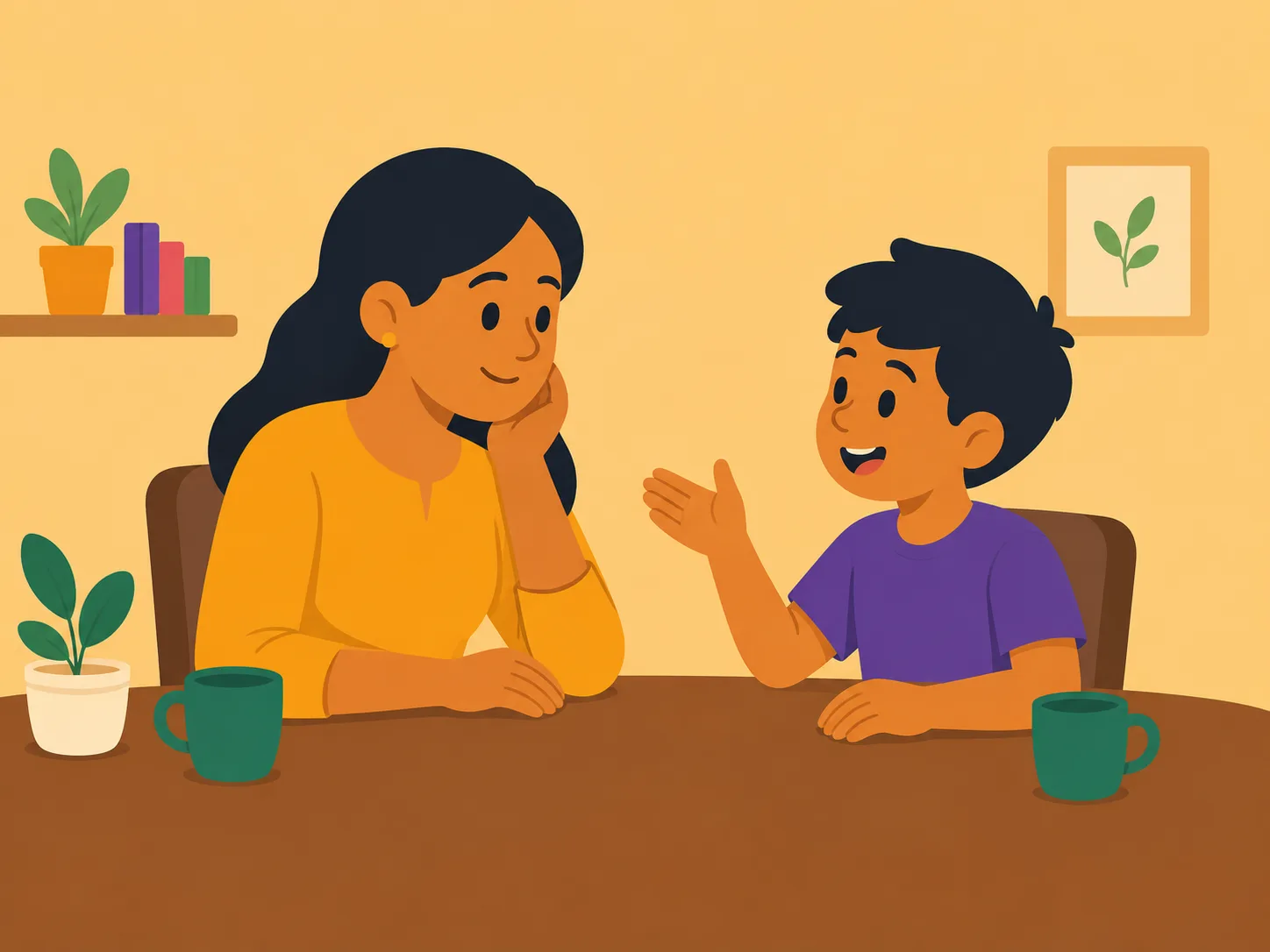
But it misreads what the child needs from you. Your child has a teacher for the syntax. What they do not have, anywhere else in their week, is somebody who is interested in what they made and has no idea how it works.
That second thing turns out to be far more valuable than it sounds. A child explaining their program to somebody who genuinely does not know is doing the single most effective thing a learner can do, which is teaching. A child explaining it to somebody who already knows is being tested, and they can feel the difference instantly.
So your ignorance is not a gap to be closed. It is the most useful thing you bring to the table, and closing it would cost you the position.
The book sets up a race you cannot win, too. Your child has four hours a week with a teacher and the reckless confidence of somebody who has not yet learned to be embarrassed. You have a full-time job and a chapter on functions. Six weeks in they are far ahead, and that gap reads as your failure when it is only arithmetic.
None of which means stay out of it. It means coming in through a different door, and the door is questions rather than knowledge.
Five questions for a child working in Python
Ask these while looking at the screen, not across the room. Point at things. You do not need to understand the answer, and you should not pretend to.
Each of these makes your child do a different piece of thinking, which is why five specific questions beat one general "how's coding going?"
If you are not sure what you are looking at is progress, the month by month markers are in how do I know my child is actually learning to code.
One rule covers all five. Ask while the program is open in front of both of you. A question about code in the abstract gets an abstract answer, and the abstract answer is always "fine".
- Point at any line and ask what it does. Whichever line you pick is fine.
- "What happens if we change this number?" Then actually change it and run it together.
- "What did you want it to do that it isn't doing yet?" This is the one that gets the real answer.
- "Can you make it break on purpose?" Breaking things deliberately is a sign they understand the joins.
- "Which bit took you longest?" You will learn more from this than from any report.
Five questions for a child working in blocks
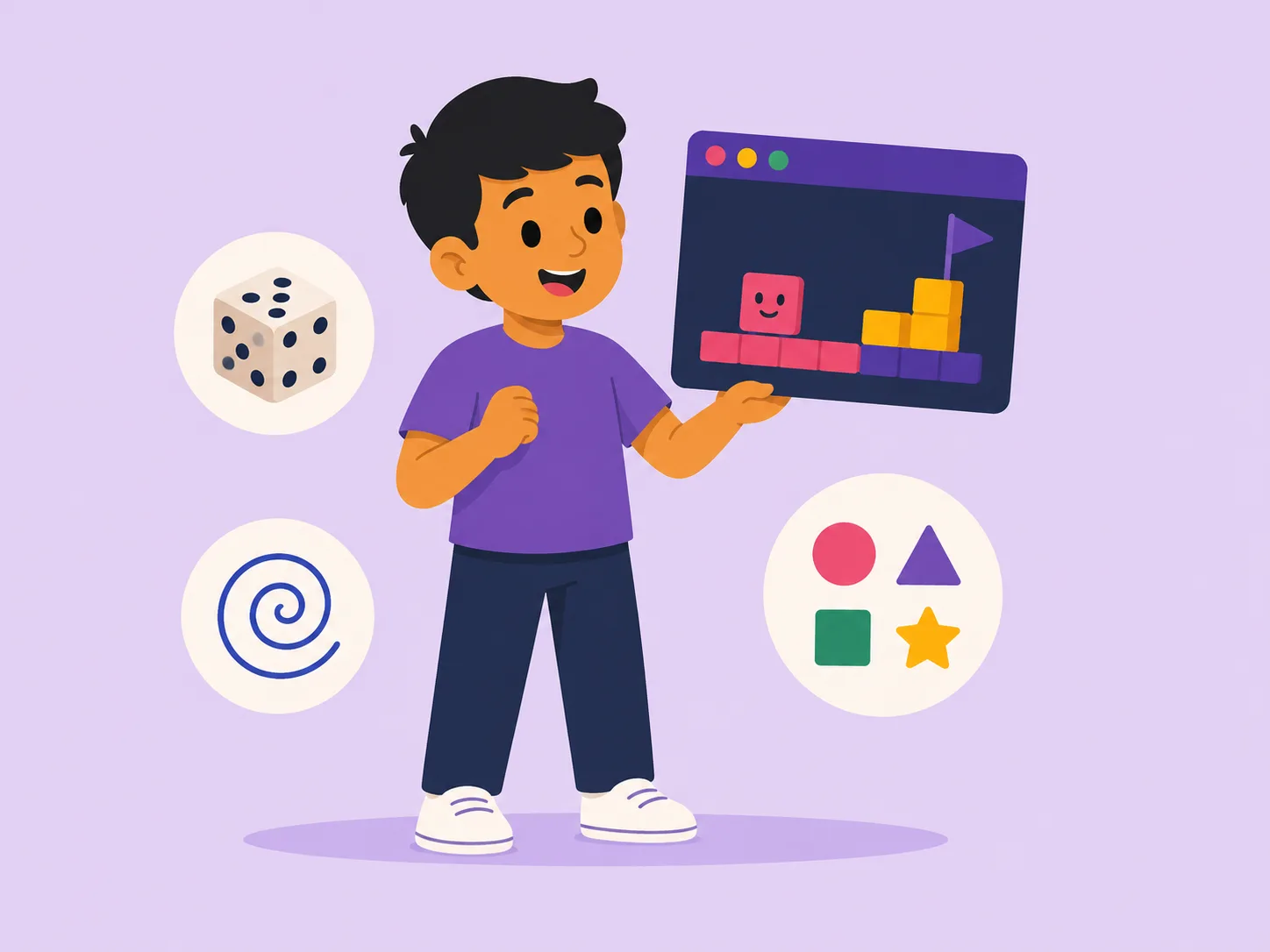
If your child is in Scratch, the Python questions land badly, because there are no lines to point at and no numbers to change in the same way. These do the same job in that room.
The advantage here is that you can see the whole program at once, which means you can ask about structure without knowing a single thing about programming.
There is one more move available in a blocks class that nobody mentions. Ask your child to tell you what is about to happen before they click the green flag. A child who can predict their own program understands it, and being wrong out loud in front of you costs them nothing at all.
- "Which sprite is the boss of this bit?" Ownership is the first idea in a blocks project.
- "What starts it?" They will point at a hat block. That is event handling, and they will not know the phrase.
- "Show me the part that repeats." The repeat block wraps visibly, so they can point rather than explain.
- "What happens if I click the green flag twice?" Usually something chaotic and instructive.
- "What did you try that didn't work?" Blocks children rarely get asked this and always have an answer.
The habit underneath all ten
Every question above is a delivery mechanism for one thing, and if you only take one idea from this post it should be this one.
Be surprised. Out loud. When your child shows you that changing a 4 to a 40 makes forty of something appear, the useful response is not "very good" but "wait, how did it know to do that forty times?"
This cannot be faked and does not need to be. You genuinely do not know. Say so, ask, and let them explain it badly. The badly is important, because a child correcting their own explanation halfway through is a child whose understanding is being built in real time in front of you.
The other half of the habit is what you do when you do not follow the answer, which will be most of the time. Say so. "I didn't get that, say it again slower" is worth far more than a nod, because the second explanation is always better than the first and your child is the one who gets the benefit of producing it.
Noticing what is worth asking about is a skill in its own right, and it is the one we think matters most in the long run. We made that case separately in the one skill AI can't replace.
Your child needs one adult who is interested and does not know how it works. That is a position you already hold.
What you can do this week
None of these need a book, an app, or any preparation at all.
Pick the one that fits your week rather than trying all three.
- Put the same half hour in the calendar twice this week and defend it. Consistency beats enthusiasm and it is not close.
- Ask your child to teach you one thing badly enough that you can repeat it back wrongly, then let them correct you.
- Ask to see something that did not work, and react to it the same way you would react to something that did.
Final thought
That mother never went back to chapter three. She started asking her son what took him longest, which took roughly ninety seconds a day and produced considerably more than the book would have.
Her son started saving things to show her, which is the part no amount of syntax on a parent's side would have bought. He had an audience who was interested and did not already know the answer, and that turns out to be a rare thing in a child's week.
For the broader version of this, our earlier piece on how parents can support their child's coding journey at home covers the habits. And on a bad day, when the answer to every question is that they are bad at this, my child says I'm bad at coding is the more useful one.
If you would like to watch somebody do this well before trying it yourself, sit in on a free trial class. Most parents pick up the questioning style in about twenty minutes. One hour, no card needed.