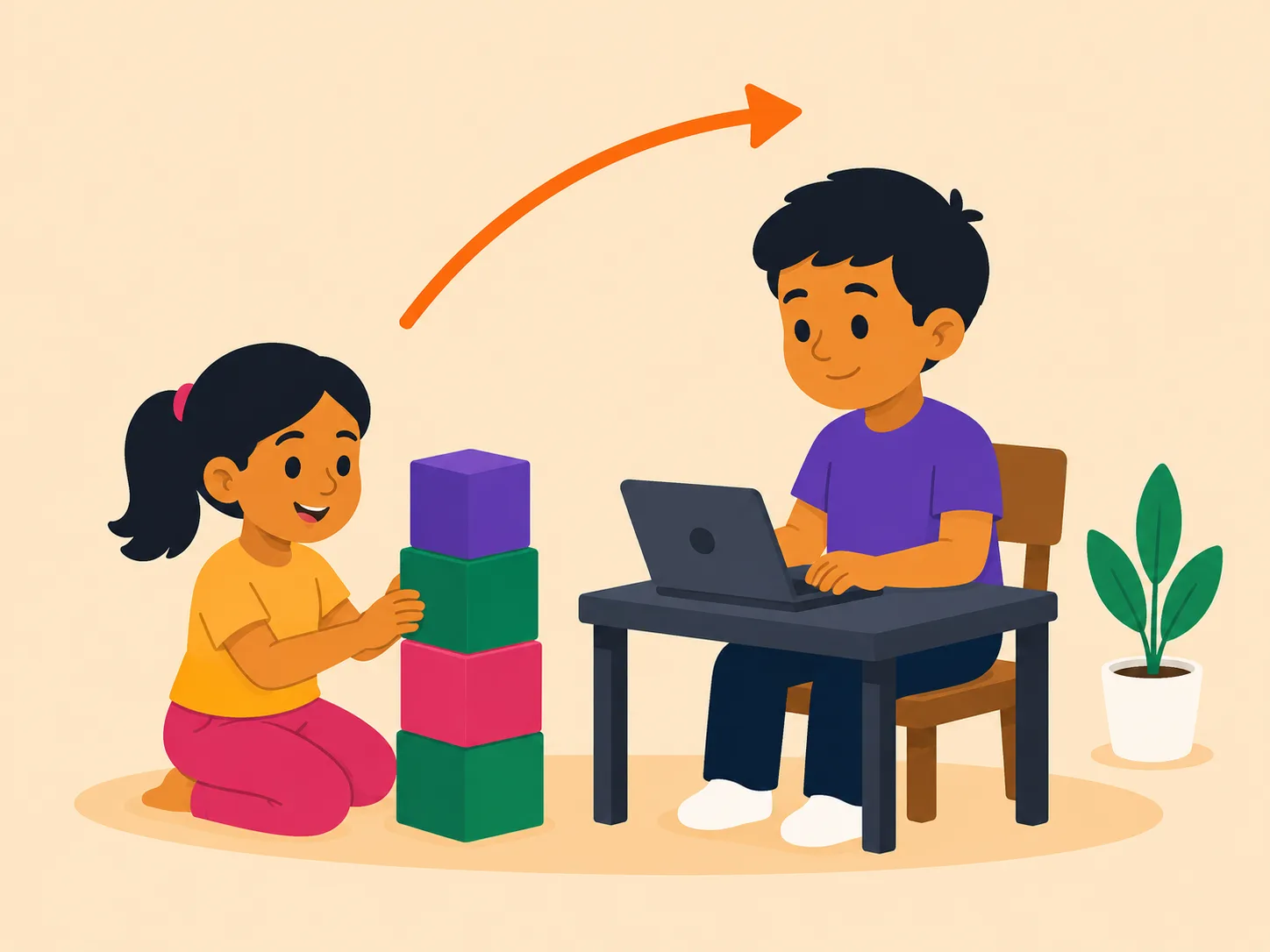
Your Child Won't Compete With AI — They'll Direct It
The jobs question, answered plainly. What happens to work when a tool suddenly gets cheap, and why directing beats competing for kids aged 10 today.
In this article
The question comes up at every parents evening, usually near the end, usually a bit quietly.
"Will there even be jobs?"
It deserves better than reassurance, so let us look at what has actually happened before when a tool suddenly got cheap. It has happened several times and the pattern is remarkably consistent.
The short version: the work does not disappear. It moves up a level, to the part of the job that involves deciding rather than producing. That is the level your child is heading for.
What happens when a tool gets cheap
The pocket calculator arrived in the 1970s and people confidently predicted the end of numerical work. What happened instead is that arithmetic stopped being the valuable part and setting up the right calculation became the valuable part.
Spreadsheets did the same thing to bookkeeping. Digital cameras did it to photography: film was expensive, so knowing when to press the button was the whole craft. Once photos became free, the craft moved to choosing which twelve of four thousand shots were worth showing anyone.
In every case the boring, expensive, repetitive layer got cheap, and the judgement layer got more valuable, not less. More photographs are taken now than at any point in history and photographers still have work.
AI is doing this to producing text and code. The prediction is not complicated. Producing becomes cheap. Deciding becomes the job. That is the same conclusion we reached from the other direction in why kids should still learn to code.
Directing is a real skill, not a shortcut
There is a lazy version of this argument that goes: your child will just tell the AI what to do, so they need no skills. That is wrong, and it is wrong in an obvious way once you watch someone try it.
Directing four different tools well takes four different things from the person doing it. A coding assistant is useless unless you can read what it hands back. An image tool is useless unless you can describe what you actually want, which is much harder than it sounds. A tool that answers factual questions is dangerous unless you can spot when it is confidently wrong.
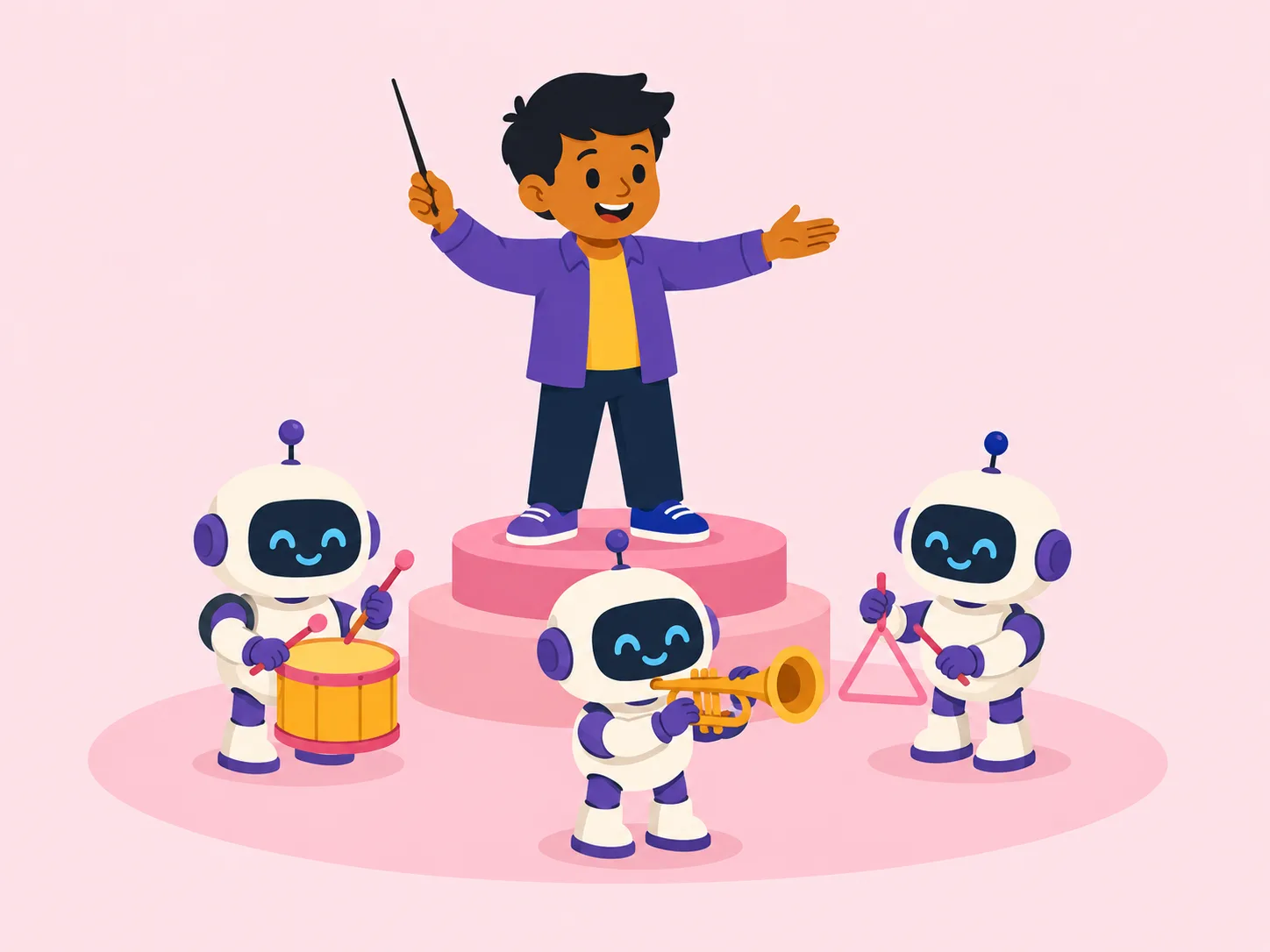
This is why we compare it to conducting rather than commanding. A conductor does not play any instrument during the concert, but a conductor who cannot read music is not conducting anything.
The part parents worry about most
The honest answer on jobs is that we do not know which ones will exist in 2040, and anyone who tells you otherwise is guessing with confidence.
What we can say is narrower and more useful. In every past shift, the people who did badly were the ones whose entire value was the layer that got automated. The people who did well were the ones who understood the layer well enough to supervise it.
Understanding does not require doing it by hand forever. It requires having done it by hand long enough that you know what right looks like. That is precisely what a few years of childhood coding gives a person, and it is cheap to acquire at ten and expensive at thirty.
Here is the sort of thing a child writes in their first month. It is trivial, and it is also the exact reflex that stops someone accepting a wrong number later.
budget = 500
price = 120

print("You can buy", budget // price, "books")
Competing versus directing
If your child tries to out-type a machine, they will lose, and there is no version of the next twenty years where they win that race.
So do not enter them in it. The race worth entering is the one where they decide what gets built, direct the tools that build it, and check the result properly before it goes anywhere. That is a different race and the machine is not in it.
We wrote about the deciding half of that in the one skill AI cannot replace, and about the checking half in if AI writes the code, what's left to learn.
A conductor plays nothing during the concert. A conductor who cannot read music conducts nothing.
What you can do this week
The aim is to get your child on the directing side of a tool once, deliberately, with you watching.
- Ask an AI tool for something together, then ask your child what is wrong with the answer.
- Get them to describe a picture they want in one sentence, then in five, and compare results.
- Tell them about a tool that got cheap in your own working life and what happened next.
Final thought
So when a parent asks whether there will be jobs, the fairest answer we have is this. There will be work for people who can decide what is worth doing and check whether it was done properly. There will be less work for people whose only contribution was the typing.
Your ten-year-old has plenty of time to end up in the first group. That is genuinely good news and it is the reason we are not worried.
If your child would rather hear this from someone who is not their parent, coding isn't dying, it's becoming a superpower is written straight to them.
The way in is unglamorous and it has not changed: learn enough to understand what you are looking at, then practise deciding. A free trial class is one hour and costs nothing. Bring your child and see which side of the tool they naturally sit on.